Strategic Leadership in Data Modernization Efforts (SLIDE)

About the SLIDE Program 

The National Network of Public Health Institutes (NNPHI) is pleased to partner with Flourish & Thrive Labs to announce the launch of the third cohort of the Strategic Leadership in DM Efforts (SLIDE) training series for Fall 2026. SLIDE is a virtual, cohort-based training program designed to equip public health professionals at varied levels of data modernization (DM) and project management experience with the skills necessary to strategically plan, manage, and implement DM activities and sustainably leverage infrastructure to modernize public health data systems. 

Utilizing participant feedback and evaluation data from the SLIDE pilot (Spring 2025) and SLIDE 2.0 (Fall 2025), SLIDE 3.0 has been refined to provide a more robust training program and peer-networking environment. 

To help participants think more concretely and practice applying acquired skills, participants will be asked to identify a specific DM-related challenge or organizational vision that will serve as the central thread throughout the entire program. Between sessions, participants will receive optional assignments that apply the knowledge from each session directly to their DM-related challenge, progressively building toward a final capstone presentation. Participants will share their insights, receive peer and trainer feedback, and collaboratively refine their emerging DM approach, creating a dynamic, personalized learning experience. 
SLIDE 3.0 Training Overview

SLIDE 3.0 will be delivered from August to November 2026, with biweekly virtual training sessions held on Thursdays. Each session is 120 minutes and includes didactic content, interactive exercises, peer-to-peer problem-solving, and dedicated time for Q&A and cohort check-ins. This training approach emphasizes relationship building, network development, and professional identity formation among public health leaders.

Session Schedule and Content toggle

August 20, 2026

Session 1: Driving organizational value through strategic data leadership

September 3, 2026

Session 2: Strategic planning for data modernization

September 17, 2026

Session 3: Data governance for public health

October 1, 2026

Session 4: Building sustainable data infrastructure for public health

October 15, 2026

Session 5: Strategic workforce developments for data modernization

October 29, 2026

Session 6: Sustainable funding strategies and responsible AI for public health data modernization

November 12, 2026

Session 7: Capstone presentations and wrap-up

Who Should Apply

SLIDE is designed for public health professionals who are currently involved in or overseeing DM activities at Public Health Infrastructure Grant (PHIG) recipient health departments. PHIG recipients with DM-related workplan activities may apply as individuals or as blended teams (up to three participants from the same agency). Individuals at all levels of leadership are encouraged to apply, including those managing up and across teams within public health agencies to foster cross-departmental collaboration. 

Participants are expected to attend at least 80% of sessions (at least 5 of 7) to receive a certificate of completion.

Application

Apply for the SLIDE 3.0 training series

Key Dates

  • Application opens June 10, 2026
  • Application closes July 10, 2026
  • Cohort will receive notice of acceptance no later than July 24, 2026
  • Training Series will run August 20, 2026 through November 12, 2026 

Contact Us

For more information or questions, please contact Helen Batts at hbatts@nnphi.org.

You can also visit our SLIDE Frequently Asked Questions (FAQ) for more information and common questions.

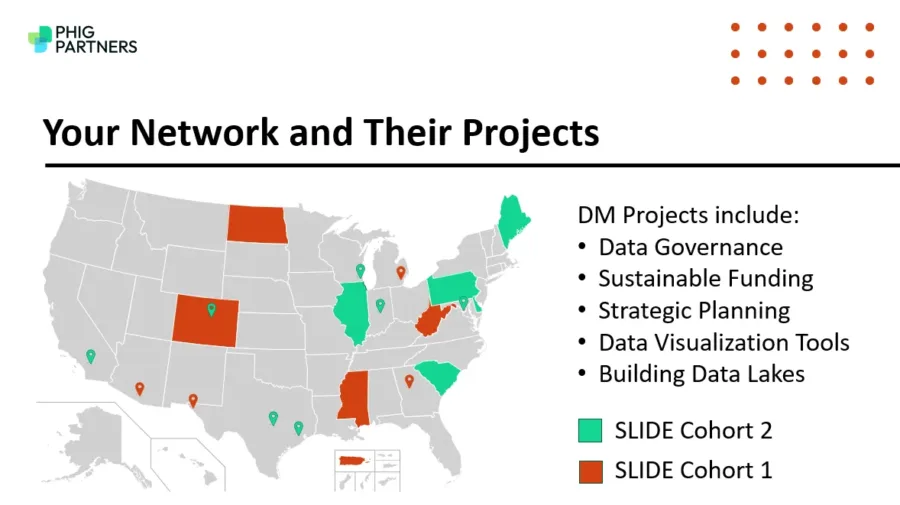
map of SLIDE network of participants
By joining the SLIDE 3.0 Cohort, you will join a network of data modernization professionals across the country who are building capacity and advancing strategic leadership in their jurisdictions.
quote
“One of the most valuable aspects was participants recognizing across different jurisdictions that they were facing the same problems and dealing with similar challenges. That shared experience really built community.“​
- Facilitator

This work is supported by funds made available from the Centers for Disease Control and Prevention (CDC) of the U.S. Department of Health and Human Services (HHS), National Center for STLT Public Health Infrastructure and Workforce, through OE22-2203: Strengthening U.S. Public Health Infrastructure, Workforce, and Data Systems grant. The contents are those of the author(s) and do not necessarily represent the official views of, nor an endorsement, by CDC/HHS, or the U.S. Government.